Will AI Take My Job? The Organizational Psychology Behind Future-Proofing Your Career
Drs Schuster & Oxley
October 14, 2026
5
Published on Workplace Psychology Insights
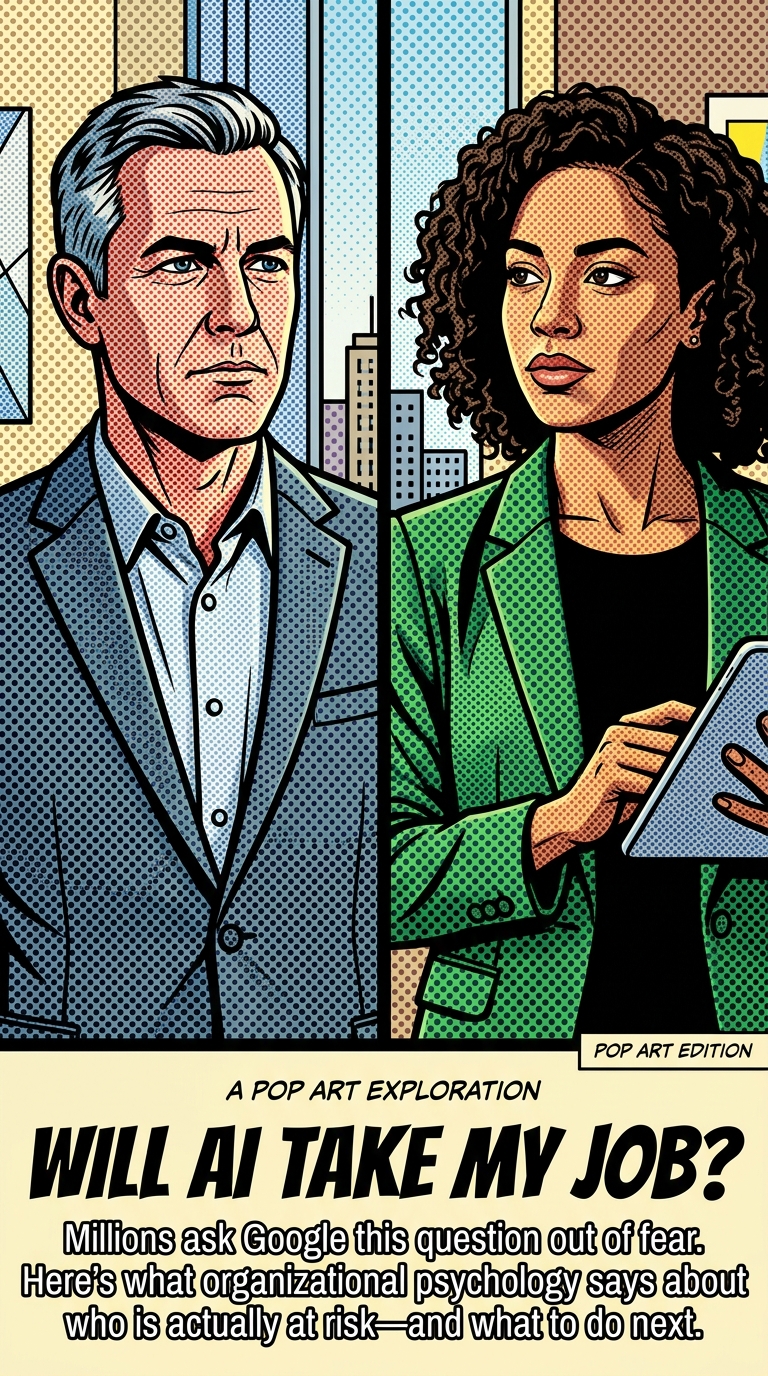
It’s late at night, you’re scrolling through headline after headline about artificial intelligence, and one question keeps resurfacing in your head: “Will AI take my job?”
If you’ve searched for this online recently, you’re far from alone. “Will AI take my job?” has consistently ranked among the most searched career questions globally over the past year. The anxiety driving these searches is real, valid, and widespread.
However, as behavorial researchers and writers of career advice books we see a critical psychological divide in how people handle this uncertainty.
Recent workforce data shows that over 60% of workers worry about job displacement due to AI, yet only about 15% take active steps to future-proof themselves.
That gap between 60% worrying and 15% acting is what we call Cognitive Paralysis. When the threat of change feels overwhelming, our brain’s natural defense mechanism is to freeze. But freeze-states leave us vulnerable. The key to surviving (and thriving) in an AI-driven workforce is shifting from cognitive paralysis to psychological agency.
Below, we break down which roles face immediate disruption versus evolution, and provide five concrete steps you can take today to build your human edge.
1. The Reality Check: Who Is Actually at Risk?
Before taking action, it helps to understand how AI is actually impacting the labor market. AI isn't replacing every job equally; it's replacing specific task types.
The Immediate Disruption Zone (High Automation Risk)
If your daily responsibilities revolve primarily around repetitive execution, data entry, routine copy generation, basic translation, or first-tier customer response workflows, your role is facing immediate automation pressure. In these domains, AI can execute tasks faster and at scale.
The Evolution Zone (High Transformation, Low Replacement)
For the majority of knowledge workers—in fields like legal, healthcare, education, strategic planning, corporate leadership, and project management—AI won’t replace you outright. Instead, it will fundamentally alter how you perform your job day-to-day.
In these fields, AI functions as a force multiplier. The real shift won't be "Human vs. AI"—it will be "Human using AI vs. Human not using AI."
2. From Worry to Action: 5 Steps to Future-Proof Your Career
Moving past anxiety requires replacing passive fear with deliberate, structured steps. Here is the 5-step framework we recommend to our executive and individual clients alike.
       [ ACTION PLAN: BUILDING PSYCHOLOGICAL AGENCY ]
 ┌─────────────────────────────────────────────────────────┐
 │ 1. Audit Core Human Skills (Divorced from Job Title)    │
 ├─────────────────────────────────────────────────────────┤
 │ 2. Set a 6-Month Upskilling Runway (Micro-Learning)     │
 ├─────────────────────────────────────────────────────────┤
 │ 3. Map Strengths to Adjacent Domains                    │
 ├─────────────────────────────────────────────────────────┤
 │ 4. Lead AI Adoption in Your Current Role               │
 ├─────────────────────────────────────────────────────────┤
 │ 5. Test a Low-Risk Side Project / Micro-Business        │
 └─────────────────────────────────────────────────────────┘
Step 1: Audit Your Core Human Skills (Divorced from Your Job Title)
Your job title is merely a label for a bundle of tasks; it doesn't define your core capacity. To future-proof yourself, strip away your official title and audit your foundational human attributes.
Ask yourself: What distinctive capabilities do I possess that AI cannot replicate?
- Complex Stakeholder Negotiation: Navigating competing political agendas and emotional nuances in a room.
- Deep Empathy & Trust-Building: Connecting with clients or team members during crisis or loss.
- Conflict Resolution: Mediating interpersonal friction where logic alone isn't enough.
- Creative Judgment: Knowing which problem is worth solving in the first place.
Step 2: Give Yourself a 6-Month Skill-Building Runway
You do not need to go back to university or earn a new master's degree to stay relevant. You simply need a consistent, manageable upskilling habit over the next six months.
- Months 1–2: Experiment with leading AI tools in your field for 30 minutes a week.
- Months 3–4: Complete an accessible online certificate or watch targeted video tutorials on prompt engineering or workflow automation.
- Months 5–6: Apply your learning through a volunteer project, community group, or internal committee.
Step 3: Map Your Core Skills to New Domains
If your current industry undergoes severe structural shifts, where else can your core attributes be applied?
A senior logistics coordinator, for example, possesses elite skills in complex systems thinking, crisis response, and vendor management. Those exact underlying skills transfer seamlessly into healthcare administration, event management, or green energy project coordination. Knowing your transferrable domains drastically reduces career anxiety.
Step 4: Lead AI Adoption in Your Current Role
The single most effective way to ensure job security is to become the person who helps your team adopt new technology safely and efficiently.
Don't wait for management to mandate new tools. Proactively explore how AI can streamline your current team workflows, reduce administrative overhead, or improve customer satisfaction. When you become the bridge between new technology and business operations, you make yourself indispensable.
Step 5: Test a Side Project or Freelance Gig
Psychological resilience grows when you prove to yourself that your livelihood isn't solely dependent on a single employer.
Consider launching a small micro-business, taking on freelance consulting gigs (via platforms like Upwork, Fiverr, or personal networking), or offering advisory services in your niche. Building a secondary income stream or portfolio project builds real-world confidence and restores your sense of professional agency.
The Bottom Line
Uncertainty creates fear, but fear only turns into paralysis if you let it keep you passive. You don't need to predict the entire future of the economy—you just need to take control of your next operational step.
What is one distinctively human skill you rely on every day that AI can't replicate? Let us know in the comments below, or reach out to schedule a consultation with our team.
Enjoyed this article? Share it with a colleague who might be navigating career uncertainty, and follow @drs_schuster_oxley on Instagram for weekly insights grounded in organizational psychology.
Related articles